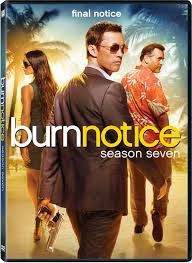
Monday, May 4, 2015

Burn Notice, Season 7, Episode 10


Michael is still drinking James' kool-aid, and Fiona lets him know this in no uncertain terms. It's interesting that she tells him he's lying about it being all about the job, he may even be lying to himself, she can tell. It's true, she can, but that also throws up a major character inconsistency about her refusing to accept that he went back to the CIA and accepted this job to keep her and the others out of jail.

Fiona's part of this episode is old school Burn Notice, and it's kind of refreshing. Carlos becomes their client, they don't show up the little notices about this sort of stuff anymore and I miss it. He pays a visit to his old neighbourhood and finds out that the drug dealer he gave up to the police knows he was the 'rat' and has a price on his head.


The only way to get out of this so the detective who worked his case tells him is to produce the witness to a murder that the dealer committed. I did wonder why they didn't go to Paxson, this would have been right up her alley. Maybe Moon Bloodgood was too busy with Falling Skies.

Sam and Jesse track the guy down and bring him to Maddy's. He doesn't want to testify because he's understandably scared. It takes some home truths from Maddy to bring him around.

Fiona and the others, are basically freelance spies, and as Michael says in one of his monologues, freelance spies are naturally paranoid because they don't have backup. So they watch Carlos meet with the detective, while hiding the witness. The detective is crooked (I knew they should have gone to Paxson), and when she can't produce the witness, the dealer shoots her and takes Carlos hostage.

He's tortured and the dealer calls Fiona and demands that she exchange the witness for him. She calls Michael, who has just returned to Miami with Sonya from a job for James. He says he'll act as the witness, and call in a favour from James.

The dealer realises that Michael isn't his guy, and just as things look very bad, Michael's phone rings. It's the dealer's boss and he demands that they let Michael and Carlos go, he refuses, so the boss tells his 2IC to kill him which he does. Michael and Carlos are released.

The rest of the episode concerned Michael's job for James. Up until now Michael has dealt with people who actually deserved justice for James, also people he didn't know. This time he's been ordered to take out an urbane British intelligence broker, who has committed no crime other than he could get too close to Michael's past. He's also a friend. Strong won't help and Michael is left with no choice but to kill a man he knows who hasn't actually done anything wrong. Michael's headed down a very dark path.

The episode ends with Carlos declaring that Fiona's life is too hot for him to handle and she's still in love with Michael, so he's taking off. It gets him out of the picture at least.

Sunday, May 3, 2015

Favourite Fantasy Authors and Books A - Z (L)

I actually thought I'd find a few L's, and I guess 5 is a few, but I just thought there would be more. One of them is so obscure that I can't even find a picture.


Ursula Le Guin is one of the most highly respected figures in the world of science fiction and fantasy. She has won multiple awards for her fiction and when she speaks the rest of the literary world listens.

She's written from the age of 11, but didn't start to be published until the early '60's. A lot of her work prior to that point was rejected by publishers as it seemed inaccessible. Her novels alone have won 5 Locus awards, 4 Nebulas, 2 Hugos and 1 World Fantasy Award (I am tempted to put a partridge in a pear tree there just for fun).

She's won the World Fantasy Award for Life Achievement, been inducted into the Science Fiction and Fantasy Hall of Fame and is a Grand Master of Science Fiction and Fantasy.

Fantasy lovers the world over know her for The Earthsea quartet. Beginning in 1968 with A Wizard of Earthsea and finishing in 1990 with Tehanu (which won both a Locus and a Nebula).

Her writing has influenced writers from Salman Rushdie and David Mitchell to Neil Gaiman and Iain Banks. She herself was influenced by J.R.R Tolkien and Phillip K. Dick (who actually attended her high school and was in the same class, although they did not know each other) and classic authors like Leo Tolstoy, the Bronte sisters, Virginia Woolf and children's authors such as Lewis Carroll, Kenneth Grahame and Rudyard Kipling.

I'm not even going to attempt to try and list her library of work, it would take forever, but she has written with equal acclaim across the spectrum of science fiction and fantasy, and will be forever remembered for her contribution not just to SFF, but to literature in general.


I fell in love with A Wizard of Earthsea when I was still in primary school. We had a copy of it in our class library (as opposed to the larger school library) and the cover with an image of a person turning into a bird intrigued me. I read it and adored it. I got less out of the two sequels (The Tombs of Atuan and The Farthest Shore), but I think a lot of that can be attributed to my age at the time and lack of understanding of the deeper themes that both books explored. I have reread them since and gained a greater appreciation, but I still prefer the opening book. It just has something that was new a different to everything else I had encountered before. I think it paved the way for me to explore books that didn't just tell a story, they tried to educate the reader, engage them to make them think and created a world that was so unlike the one in which we live. Highly recommended for anyone wanting to truly understand the genre and find out why it speaks to so many readers.

Further and related reading: once you've read A Wizard of Earthsea you will want to follow Ged and find out more about his world and his art, and the best place to do that is with the two sequels; The Tombs of Atuan and The Farthest Shore. There is a fourth book (it's a quartet after all), Tehanu, but that came out in 1990 (The Farthest Shore was published in 1972) and the intervening years have made it a very different book from it's predecessors, which I still regard as a trilogy. There's also a collection of short stories Tales of Earthsea. A 'fifth' book in the 'quartet' The Other Wind came out in 2001 and won the 2002 World Fantasy Award. It's a sequel to Tehanu and also relates to one of the stories in Tales of Earthsea.

I personally find J.K Rowling's Harry Potter series to have strong influences from A Wizard of Earthsea. I don't think I'd ever seen a proper school for magic until I read A Wizard of Earthsea. Rowling took that concept, married it with any 'girls own' school book you care to mention and created Hogwarts. Patrick Rothfuss' Name of the Wind also owes a great deal to A Wizard of Earthsea. I actually quite often call the book A Wizard of Earthsea meets Harry Potter. Lev Grossman's The Magicians is another book that explores the idea of learning magic in a school environment. None of them however explore the other themes in the way that Le Guin did in A Wizard of Earthsea, which is still ground breaking in many ways.


C. S Lewis - November 29, 1898 - November 22, 1963. Not many people don't recognise the name C.S Lewis, and he along with his friend and colleague J.R.R Tolkien is one of the biggest names in fantasy.

Like Tolkien, Lewis served in WW1 and upon his return from active duty commenced a position at Oxford University. He and Tolkien both worked in the English faculty at the school, and they were also both members of the writing group called The Inklings.

He's best known for his Narnia Chronicles, which was a fantasy written for children, that was very heavy on the Christian allegory (Lewis was raised in the Church of Ireland, but became disillusioned with religion and was briefly an atheist in his mid teens. He returned to the church in the 1920's and eventually became a very committed Anglican from 1931 onwards), however he also wrote a science fiction series, The Space Trilogy. He also wrote a number of scholarly articles on Medieval and Renaissance Literature and wrote about his faith.

In recent times he has been labeled a Christian apologist, but remains one of the most widely read British authors of all time, and was ranked 11th in a 2008 list of the 50 greatest British authors since 1945 by The Times.


I don't think this list would be complete without The Chronicles of Narnia. For the time they were written in a very odd fashion. Lewis did not write them linearly at all. There's still debate even now over what the correct reading order should. Published order versus chronological. I originally read them all out of order, I started with Voyage of the Dawntreader (3rd published book), and then read the others as I found them. If read chronologically they start with The Magician's Nephew and end with The Last Battle, if read in published order they begin with The Lion, The Witch and the Wardrobe and finish with The Last Battle. Over the course of their seven books, they tell the story of the world of Narnia from it's birth in The Magician's Nephew to it's end in The Last Battle. It's also the story of Aslan (God) and to a lesser extent that of the Pevensie children, who initially rediscover the world via a portal in a old wardrobe in The Lion, The Witch and the Wardrobe, and those who carry the torch once the Pevensies become 'too old' to believe and move on. One of the books The Horse and His Boy, takes place entirely on Narnia and doesn't feature any of the Earthly protagonists, the Pevensie's are seen from afar, as it takes place during the reign over Narnia and both begins and ends during the final chapter of The Lion, The Witch and the Wardrobe. Because time passes differently in Narnia (years here are centuries there) reading the books in any order can be a little bit mind bending. I felt Lewis really let his imagination run wild in these and if you can ignore the Christian allegory they are a lot of fun. One of Lewis' influences as a child were the stories by Beatrix Potter, and there are plenty of anthropomorphic animals in Narnia, from Aslan the giant lion to Reepicheep the valiant mouse duellist. They make quite an enjoyable fairytale if approached correctly, and they do over the course of their 7 books tell a very complete story. They tend to be a lot of readers entry to epic fantasy. There was an attempt to film the series, which started with The Lion, The Witch and the Wardrobe in 2005 and finished with The Voyage of the Dawntreader in 2010. I believe there were plans to film all of the books, but the films were never as successful as anticipated, and eventually the idea was wound up. I think when they got to titles like The Horse and His Boy and The Magician's Nephew they would have run into chronological issues in any case, as they seemed to be making the films in publication order.

Further and related reading: Lewis wrote science fiction, scholarly work and Christian work, but nothing else quite like Narnia. There have been a number of biographies written about him, at least one by close friend Roger Lancelyn Green (I best remember Green for his adaptations and collections of classic myths and legends). A screenplay called Shadowlands about his relationship with Joy Davidman Gresham was made into a film starring Anthony Hopkins as Lewis and Debra Winger as Gresham.

Authors influenced by, or who remind me of Lewis' work are legion. Eoin Colfer's Artemis Fowl series, Harry Potter again, The Magicians by Lev Grossman again, his fictional world of Fillory may as well have been called Narnia. Phillip Pullman's His Dark Materials series was influenced by Lewis in that it is highly critical of what Lewis did with Narnia, one of the central characters also comes from Oxford, but in an alternate Earth.


Norman Lindsay - February 22, 1879 - November 21, 1969. Norman Lindsay is probably better known as an artist than a writer, but entire generations of Australian kids have grown up with his classic The Magic Pudding.

Norman Lindsay worked across the artistic mediums. He drew, painted, etched, sketched, cartooned and sculpted. He was quite well known for his nudes and became rather controversial because of it. A feature film called Sirens and starring supermodel Elle McPherson came out in 1994, and was a highly fictionalised version of Lindsay's life at the time and the controversy that surrounded his lifestyle and work.

He wrote more than one novel, but he will always be remembered for his irreverent and very Australian fairy tale The Magic Pudding, he also illustrated it himself, and the drawings do add to the story.


The book is also subtitled The Adventures of Bunyip Bluegum. Bunyip Bluegum is an adventurous young koala, who fed up with his father's habit of not shaving his whiskers and letting them get everywhere, leaves his tree and goes out to seek his fortune on the road. He meets up with two sailors, Bill Barnacle and Sam Sawnoff (a penguin), who are in possession of a magical pudding called Albert. What makes Albert magical is not only the fact that he sprouts legs and arms, and wears his bowl as a hat and that he can talk (he's frightfully rude), but that no matter how often he's eaten (he can be a steak and kidney pudding and then turn into a plum pudding for dessert) there's always more than enough to go around and he never runs out. This makes him not only magical, but valuable and Bunyip, Bill and Sam are having to continuously fight off attempts from a couple of 'pudding thieves' (a possum and a wombat) to steal him, mind you Albert can stand up for himself too.

The book is divided into slices and it's wonderful fun, filled with odd concepts, poems, adventure and magic. It's so very Australian, and could only have been written by an Australian. It's been one of my favourites from the time I first read it as a child, right up to now.

Further and related reading: Lindsay only wrote the one genuine children's book that I am aware of, and this is it. I'm going to really only talk about Australian works here that I find similar, and that were either influenced by or influenced The Magic Pudding. Mae Gibbs was an Australian author and illustrator, she's known for her drawings and stories of the gumnut babies Snugglepot and Cuddlepie. The stories came out mostly after The Magic Pudding, but the drawings came out just before, and their Australianess may have influenced Lindsay a little. There's no magic in the stories (other than the anthropomorphic Australian animals), but the mischievous koala Blinky Bill by Dorothy Wall may have drawn her inspiration for the character from Bunyip Bluegum. I Can Jump Puddles author Alan Marshall clearly drew on The Magic Pudding for his own Australian fairytale Whispering in the Wind and I can even see the influence of Lindsay's story in the work of Mem 'Possum Magic' Fox.


Because I was unable to locate a photograph of A.R Lloyd I'll cover both author and book together. A. R Lloyd's first name is Alan. He publishes his work for children, like Kine, under the name A.R Lloyd and his more serious adult work, mostly historical non fiction is published under the name Alan.

His children's work is like Richard Adams, about animals in the wild. They look, act and behave like wild creatures, but they interact like humans and have human emotions. Kine is about a weasel, which is odd, the only other person I know to feature weasels as heroes was Garry Kilworth. The book is about one magical summer when the boastful, carefree Kine, meets the pretty Kia, has a litter of his own and with his friend weasels, as well as voles and shrews take on and defeat the escaped mink that are trying to take over his forest. It's quite deeply affecting emotionally and I confess that one section moves me to tears. It's part of the Kine saga, which tells other stories, not just Kine's. Kine is also apparently another term to describe a weasel.

Further and related reading: there are the other two Kine books, Witchwood and Dragonpond, I've read both, but only Kine spoke to me that way. Most of Lloyd's 'fantasy' work relates to animals. He's very like Richard Adams, although he clearly chose to use different subjects. Like Garry Kilworth he used weasels as his heroes, although unlike Kilworth's Welkin Weasels, Lloyd's aren't anthropomorphised, they're similar to Kilworth's mice in The House of Tribes in that respect. There's also elements of William Horwood's Duncton Moles.


Scott Lynch is really the odd man out here. He's certainly the youngest on the list and he'd probably be embarrassed to be included in such company as Ursula Le Guin, well that's what happens when your surname starts with L.

Scott Lynch worked as an occasional game developer and mostly as a firefighter and rescue worker when he got the idea for a book that he would come to call The Lies of Locke Lamora. He belonged to a writing group at the time and decided to post his attempts to write an epic fantasy novel on the internet. I think the site was called something like Adventures of a Newbie Writer.

One of the editors at Gollancz (Simon Spanton) was alerted to the existence of the first chapter online by a member of Scott's writing group. He read it, liked it, asked for more and hey presto best seller. Even Scott says that this was a one in a million chance and does not recommend it as a way to try and get published.

The Lies of Locke Lamora met with much hype and acclaim and sold very well. The sequel Red Seas Under Red Skies hit the streets not that long after and also did brisk business. That's when the author hit a roadblock. The publication date for the 3rd instalment in what had come to be known as the Gentleman Bastard series kept getting pushed back and pushed back. Scott's website and blog went silent. Eventually the news broke that the author himself was dealing with depression.

It took some time and plenty of people speculating that it would never happen, but in 2013 the 3rd book in the series; The Republic of Thieves, did come out, and was well received. We're still waiting on the 4th novel, The Thorn of Emberlain, but the most recent news says it will be out sometime in 2015.

Scott maintains a website: scottlynch.us (which seems to change at random and on a whim), he also tweets regularly as @scottlynch78 (I'm not sure who the other 77 are, or if that's a birthdate).

I'm not even going to attempt to review this seriously. I can't. My love for this book is ridiculous. I first picked it up after plenty of buzz and seeing that the 2nd book was out, so I wasn't going to be left hanging off the edge of an enormous cliff for years (yes, I am looking at you George R.R Martin!). I started it on the way back to work and by the end of the first page I was totally hooked. The whole thing was like a shot of nitro glycerine to the brain. After finishing it, I closed it, flipped it and reread it again. I can't remember the last time I did that. I've read it something like 15 times. Every time I find something new to discover. My battered old paper back remains one of my most treasured books because I was lucky enough to meet and speak to Scott at Worldcon on 2014 and get him to sign and personalise it. I'd have to say that its my favourite book of all time, regardless of genre.

Further and related reading: unfortunately there's not a lot. The Lies of Locke Lamora is fairly self contained, part of why I broke my rule of not including unfinished series in here, but if you like it, you will want to read on. Red Seas Under Red Skies adds pirates into the mix and the more recent The Republic of Thieves continues the adventures of the world's most likeable conman. Scott has a few short stories out, I can personally recommend A Day in Old Theradane from the Rogues anthology, and while he hasn't stated it, I can see it as being a sort of prehistory to the world in the Gentleman Bastards series. He also has some of a pulp science fiction novel he started serialising as a form of therapy online. The Queen of the Iron Sands, it may still be on his website.

When recommending Scott, people tend to recommend the usual suspects: George R. R Martin, Joe Abercrombie, Pat Rothfuss, etc... I don't think they have anything in common to be honest, other than that they all write epic multi volume fantasy. The city of Villjamur in Mark Charan Newton's Nights of Villjamur put me in mind of Lynch's setting of Camorr in The Lies of Locke Lamora. Lynch himself was quite heavily influenced by Fritz Leiber's stories of Fafhrd and the Grey Mouser, and that's quite obvious when you read them.

Next week onto the M's, that should be fun.

Burn Notice, Season 7, Episode 9


I'm not sure if watching so many of these back to back has affected me or not, but I had very little interest in the main story of this episode. I'll cover it here just to get it out of the way.

James wants Michael and Co to ensure that a prominent middle eastern reformer is not assassinated while in Miami. They protect the target from gunmen, but not before he's been poisoned. This then sparks a chase to find the poisoner, because they can't reverse engineer an antidote. The whole mess gets resolved, but not before James' expert on middle eastern affairs throws Fiona under the bus by leaving her in a burning factory. Michael rescues her, and I don't think the relationship with Carlos will survive, because Michael and Fiona are definitely back on after this.

What interested me more were peripheral things to do with James. Firstly he rounded up Michael and the other 3 by having them met at their places of residence or about their daily business and taking them to a place of his choosing. So the job he wanted them to do wasn't really about a choice, it was about doing it or else. While what he does seems altruistic, his strong arm methods put Sam, Jesse and Fiona offside and even have Michael asking questions.

He also has Maddy under surveillance and makes threats against her and Charlie by turning up at her house. If he wants to lose Michael this is the way to do it.

Lastly the real James comes out at the end of the episode when he finds out what his man did with Fiona at the factory. His special forces training is all about not leaving anyone behind. Sam's said it about his SEAL days more than once and so has Michael about his own special forces experiences. James is cut from the same cloth, but he takes action that neither Sam or Michael approve of, and that's to shoot the transgressor dead without any hesitation whatsoever. He's too much judge, jury and executioner and like Simon and Card, he's not dealing with a full deck.

Thursday, April 30, 2015

Burn Notice, Season 7, Episode 8


This is where, not only I, but other members of the cast start to question just how deeply James has got his hooks into Michael's mind. He looks and acts like he always has, and he seems to do the right things, but James pushes certain buttons that Michael can't deny are attractive to him.

This time he offers Michael the opportunity to go after a Dominican drug lord. Michael and Sam go in, get the guy and deliver him to James, who will serve up his own brand of justice. The only reason the guy is still operating is because he's an MI6 asset.

This is Michael's dream. Taking people like this out of the picture was what he was all about when he first started white knighting. Only he was always under resourced and couldn't move up the food chain as high as he wanted. James provides him with weapons, funds, travel, everything.

Sam's concerned about how much Michael seems to be buying into this. The drug lord was an interesting character. Played by Peter Mensah (Onemaus in Spartacus) he had the British accent that made his Eton educated drug lord believable, and he's a scary guy. Shame it's only a once off.

The only indication that Michael has genuine doubts about James comes after they deliver the drug lord to him. Rather than take he and Sam on the boat with him, where I have little doubt they're going to feed the drug lord to the sharks on the way, he gives them fake id and tickets back to Miami.

In Miami, Fiona is reluctantly working with Strong, because she has no option, but both Carlos and Madeline are concerned about what it's doing to her. Carlos actually doesn't even know she's doing it and when Maddy finds out she counsels Fiona to be careful and tells her that she'd probably be better off with Carlos than Michael in the long run. I really wish they'd been able to recast Sharon Gless as a CIA commander, she'd be really good at it.

Fiona and Jesse along with Strong and his team are going after a long term mental patient, who was also a Delta Force team member, and means something to James. Jesse manages to get him to give up a name; James Kendrick.

In an interview with Michael he tells him that Kendrick was his friend and his commander, until something snapped in Mogadishu and he killed his entire team, with one exception and he had him committed. Michael agrees that James is possibly the most dangerous and possibly insane person he's encountered. I personally think Simon, Anson and Card may disagree, even Larry. Fullerton could run rings around James.


Wednesday, April 29, 2015

Richmond V Melbourne 24/04/2015 (MCG)


It was a special night being Anzac Eve, and there was a special tribute to the soldiers before the game, with a torch being carried around the ground by an escort of light horsemen. Then former Melbourne champion, Ron Barrassi (whose father was a casualty of WW 2) lit the eternal flame at the ground to kick the round off.

I don't think it really stirred the players that much, although it was received respectfully by the crowd. I think it's a good initiative and I hope they keep doing it. There is talk of making the match a regular thing, similar to the way that Collingwood and Essendon square up on Anzac Day.

I'm not really going to talk much about the game. Richmond started off well with a goal to Ben Griffiths in fairly short order, but that was about as good as it got. The Demons led at every change and after the rain came early in the 3rd quarter the Richmond players seemed to give up. Admittedly they had 2 on the bench by that stage. Debutant Drummond had done his knee and was facing a year out. Ben Griffiths picked up an injury that meant he couldn't play on and Cameron Hunt was playing with a foot injury, which affected his game. Very disappointing. 

I knew this post was coming. I hoped it wouldn't be this early in the season, but it has. Richmond do this on a regular basis. Lose games that they're expected to win. It wasn't a case of them turning up thinking they'd win. It was a case of them losing on every front. The bad players continued to play poorly, and even the good players, with the exception of Shane Edwards, didn't play well. Melbourne's good players stood up, and even some of their ordinary ones played above themselves. Damien Hardwick was completely outcoached by Paul Roos and that's happening far too often.

I can't say much more other than that I've got a feeling of deja vu.


Seeing too much of this.


And this.

I said it on the night and I'll say it again now. Not good enough Tigers.

Burn Notice, Season 7. Episode 7


Michael's slept with Sonya and they both survive the experience, so now he's worthy to take his induction into the organisation that she works for a step further.

This is kind of like applying for an executive position with added torture thrown in. Michael is taken to an undisclosed location, although I don't think he was in a head bag (he really hates that), then set up in a room where he is interviewed/interrogated by a older looking hippy dude. The hippy does turn out to be the organisation's leader, and the audience are intended to believe that he is, but he could be a professional interrogator. Sonya could even be the boss for all we know.

In between being grilled on all his previous experience and life as a spy, Michael is drugged, kept awake and locked in a featureless room with loud noises piped in. Understandably he becomes disoriented and hallucinates. One hallucination is Fiona dressed in a red dress, telling him that he has to give up and tell his questioner everything, he has to fail them all.

Other regular hallucinations feature Larry and Frank. There seems to be a correlation made between the two. They were both father figures and they were both abusive, they both forced Michael into doing things that he didn't want to do, and they both made him into something he never wanted to be. He does finally break down under the questioning and admit that Larry pushed him into blowing up a factory to get a target, but he also took out innocents. It's this incident that plays on his mind ever since he did it and that he's tried to make up for, but perversely it's also what made him a legend and a desirable asset.

Sam, Jesse and Fiona go on the hunt for Michael and track him down to a private island. They can't drive in, but they can watch it from the water and use Elsa's speedboat to do it, they may even be able to attempt a rescue.

Sonya comes to Michael's cell, asking him what he told the interrogator. He's drugged and disoriented, exhausted mentally and physically and he can't remember. She says they have to get out, and helps him out of the house and onto the beach.

With Sam, Jesse and Fiona watching, Michael does not know this, though, he breaks away from Sonya and effectively gives himself up to the armed men following them.

Back in the room he was interrogated in, the hippy pulls a gun and points it at Michael. Michael seems lucid again and he said that he's given him everything and he won't kill him now, because he came back, if he wasn't part of whatever they're selling he wouldn't have done that.

The gun is unloaded, the hippy introduced as James, Michael is welcomed to The Family, and it's smiles all around.

James has this whole charismatic cult leader thing happening and I wonder if the name is from Jim Jones, the leader of a religious cult and responsible for the Jonestown mass suicide, the origin of the comment to 'drink the kool-aid' comment to indicate someone who has been brainwashed by a radical ideology. Then there's the name The Family, which makes me think of death cult leader Charles Manson, who referred to his followers as Family.

Michael winds up sleeping on the couch at Madeline's, with his friends trying to work out what he's gotten himself into. Apparently James bulldozed a $10,000,000 mansion just so that he couldn't be tracked down by anyone.

Then there's Michael himself. Does he really believe what James sold him? Was he faking that? He's mentally strong, but what they did to him could break anyone. He's so good at false facing and done it so often, does he really know what he believes or stands for anymore? Is Michael the Big Bad of Season 7?

Tuesday, April 28, 2015

Burn Notice, Season 7, Episode 6


 Now that Michael's mission has moved back to Miami, Michael has in many ways returned to his old life. Even down to moving back into the loft and tucking Sonya away there. When they were on the run last season I thought that they torched the loft, I even saw them set it on fire. However it didn't actually get burned to the ground, it just looks a little bit charred from the outside. Michael tells Fiona that a few of her snow globes survived if she wants them, when she comes around to face him down and let him know that she's been forced into working with him. She also sees Sonya there and sparks fly. The two ladies don't come to blows, but they clearly don't like each other, and the reason is Michael Westen. I actually find it a little churlish of Fiona to feel this way toward Sonya. She's repeatedly rejected Michael and made it quite clear that she wants as little to do with him as possible, she's flaunted her relationship with Carlos in front of him, so why shouldn't he take up with Sonya? Not that he has at this point. Fiona's behaviour smacks of I don't want you, but I don't want anyone else to have you. It's not only disrespectful towards Michael and Sonya, it's also an insult to Carlos.

The plan is to go after the hackers that outed Sonya. Exactly how this helps the mission I don't really understand, although I think it may prove to Sonya that Michael is really on her side and get him to take him into the organisation that she's part of.

To get into the hackers group they need the assistance of someone else and that someone else is Barry. I had been wondering about Barry. However Barry is not all that disposed to helping Michael, because his association with the former spy had him locked up for 4 months, during which time he lost his girlfriend, his house and played havoc with his client list. The hackers also have a certain reputation for taking down anyone who crosses them and they've stolen some of his clients. Sam and Jesse can't do much about his house or his business, but they can at least help him track down his girlfriend. Because Barry really does like Michael and his friends he agrees to let that stand as payment, besides if Michael performs his usual bang up job on the hackers that will remove them from the board.

So, we had two stories running again. One is the take down of the hackers, which mainly utilises Michael and Fiona masquerading as a pair of hackers, with Sonya running outside interference for them. The other was Sam and Jesse helping Barry with his relationship issues.

The second of those was a little sad. They managed to find the girlfriend because of a bright orange Lamborghini that turned up at a dodgy car dealership (an orange Lamborghini, that is so Barry). Unfortunately she'd moved on and had another boyfriend. She liked Barry, but his lifestyle bothered her and she wasn't heartbroken to have an out.

Michael and Fiona establish themselves as the real deal with help from the rest of the group outside. The hackers were an interesting bunch. They ran the operation like a corporation, with the hackers sitting in an office, working away and being closely monitored by one of the guys behind it. Even going out for a smoke break seemed to be a major issue, admittedly Michael was doing it so that he could get on the roof, abseil down the side of the building and drill through the wall.

The whole operation was overseen by a menacing moustached character wearing a sharp suit. This was Frakes, played by Charles Mesure. The accent was rather like an English one mixed with Australan. This makes sense as Mesure was born in England, but grew up in Australia. I remember him from V, and he does play a heavy quite well, which is what he does here. Fiona and Michael throw his underling under the bus, and then the whole operation gets broken up by the authorities. As a bonus Barry gets the information that they stole from him back.

Back in the loft Michael convinces Sonya that she and her operation is all he has left. He's convincing, because in many ways he is telling the truth. He has lost Fiona, but he does still have his mother and the friendship of Sam and Jesse, which he makes her believe is not the case. I found it interesting that he said his relationship with Maddy was irreparably damaged due to what happened to Nate, because while she doesn't give a lot of outward signs that she still blames him for the death, he may think that.

Michael and Sonya sleep together and he knows he's in. Again this was interesting and an idea of how far Michael has turned. He's come to the point of having to do something in the course of his work on a few occasions, such as kill an innocent or sleep with someone other than Fiona, and he's always found a way out at the 11th hour, but this time he went through with it, and I don't think he cares for Sonya overall, she's just a means to an end. Michael could be on a very slippery slope here.