Showing posts with label John Irving. Show all posts

Sunday, August 6, 2017

The Great ReRead Project Mark III - The Letter I


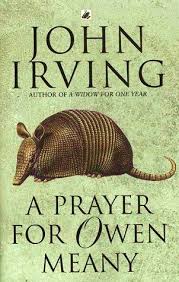
I’m not really sure how to review A Prayer for Owen Meany. I’ve never actually reviewed a book quite like it. It’s not science fiction, and it’s not fantasy (although it could be argued that Owen’s long held belief that he saw his own gravestone in the set of a local production of A Christmas Carol in which he played the Ghost of Christmas Future as a child and then his later dreams that he also saw his actual death is a fantastical element. There’s also his and his parent’s belief that he’s the result of a virgin birth). A Prayer for Owen Meany, is like a number of author John Irving’s works, an excursion through the life of an extraordinary individual, set in the New England area of the US and mostly in the 50’s and the 60’s.

It isn’t actually the first John Irving book I’d ever read. Prior to seeing A Prayer for Owen Meany, I’d read The World According to Garp and Cider House Rules,  in fact I think I’d seen the films based on those books as well. They did later base a film on A Prayer for Owen Meany, it was called Simon Birch, it only covered the early part of the book and changed the ending, which seemed to bear out the author’s belief that the book wasn’t really filmable.

Despite not being the first of Irving’s novels that I’d ever read it is my favourite and the only one I think I’ve ever read more than once.

Owen’s story is told by his best friend John Wheelwright. John is one of the most passive narrators I’ve ever encountered in fiction. He’s a character who is remarkable by being completely unremarkable. For most of the book John lives completely in Owen Meany’s shadow, which considering the fact that Owen is physically undersized for all his life (never even reaching 5 feet in height) is quite an achievement. But Owen is that sort of character; he’s larger than life and just seems to overwhelm everyone around him.

The story is told in quite an unusual structure and in the hands of a lesser writer than Irving probably would have failed.  It moves in and out of time, backwards and forwards, even in John’s reminiscences made from the safety of 1987. The second half of the book tends to follow a more linear path, with John’s current day interludes breaking up the continuing journey of Owen and John to it’s inevitable and tragic end.

The reminiscences about Owen’s life back in Gravesend do have a rather surreal quality about them and at times I wondered if they all really happened, and if they did were they as reported by John down the passage of years, from his embittered self imposed exile in Canada. I did start to think that maybe John was in fact an unreliable narrator and Owen and many, if not all, the folk in Gravesend were in fact not real, but fictional constructs that he used to make sense of his life. I later came to the conclusion that this was not in fact the case, but it was an interesting thing to consider at some points of the book.

The first half of the book is for me, more enjoyable than the second. In part this may stem from Irving’s affection for New England small town life in the 50’s and early 60’s. As he grows I found Owen to become a less likeable character and the wider world intruding on the lives of the folk of Gravesend, New Hampshire, gave it a more sinister feel. John’s interludes in 1987 became more frequent and longer and I really didn’t found John, his musings on religion, virginity, the Reagan administration (in particular the Iran contra affair) and classic literature, all that interesting. Owen’s speech had by then also become a little bit tiresome (Owen has a ruined voice, and every time he speaks everything he says is capitalised to emphasise how odd his voice actually is, at the start of the book when he’s a child it’s quite fun, but it becomes wearing as he grows).

I always have a deep sorrow for John and Owen when Owen accidentally kills John’s mother. I actually feel sorrier for Owen than I do for John, which is weird, because John’s the one who loses his parent. I should explain the nature of the death.

Due to his size Owen is not much of an athlete, but he does like baseball. Both he and John play on a Little League team. Owen can barely hit a ball and every time he tries he just about knocks himself off his own feet. However because he’s so small he has an almost non existent strike zone, which makes him a useful player if a base is needed.  Owen will nearly always get walked. On this one day he goes up to bat and is encouraged to ‘swing away’. He misses the first two pitches, but connects on the third. It’s a foul ball and it hits Tabby Wheelwright on the sidelines, who has stopped by to see the boys play and was distracted by someone in the crowd so wasn’t looking when the fateful struck her in the head and killed her instantly.

It’s the only ball Owen ever hit, it was a foul and it killed the mother of his best friend and a woman he had more affection than his own mother. Owen’s mother is a shut in, she’s more than likely mentally ill, and Tabby seemed to sort of adopt him. Now he killed her. The image of Owen desperately telling John ‘I’M SORRY!’  and then running away is one of the saddest things I’ve ever read and I feel so much for the character in that moment.

There’s a deep longing from John to go back to those days of the early 50’s when his mother was still alive, before he and Owen went to Gravesend Academy, before President Kennedy was elected and before the US got itself embroiled in a foreign conflict from which John never seemed to recover, and Owen did not survive.

Despite its flaws (it’s too long for one), A Prayer for Owen Meany is a book that never fails to make me think, smile, frown, laugh and cry. It’s a worthy entry in the Great ReRead Project.

Sunday, April 12, 2015

Favourite Fantasy Authors and Books A - Z (I)

I almost couldn't find an I author. There are authors who write fantasy beginning with I (Ian Irvine and Eva Ibbotson spring to mind), but I either haven't read them or wouldn't list their work amongst my favourites. So to get someone I had to think outside the box a little and I've probably stretched the definition of the genre to breaking point and beyond, but here goes anyway.


The distinguished looking man holding the Oscar above is not a film maker, he's a writer, although films made out of his books have been nominated and won Oscars. That picture was probably taken in 1999 when he won the Academy Award for the best adapted screen play. The book and film were The Cider House Rules, and the man in the picture above is John Irving.

John Irving grew up in and around academia, his stepfather was a faculty member at the Phillips Exeter Academy. John Irving attended the school and has set a number of his books in and around it. He's been writing since 1968, when his first novel (Setting Free the Bears) was published. It took him ten years and two more lukewarm receptions to achieve best seller status in 1978 with The World According to Garp. This was later made into a very successful film starring Robin Williams in the title role. The World According to Garp was the first Irving novel I read, and it was prompted by a work mate lamenting how an awful film ruined a good novel. I'd actually seen the film and liked it, so I read the novel. It is very different, but I don't think the film did that bad a job of it to be totally honest. I didn't read everything Irving wrote, but I did like a couple of his other better known novels in The Cider House Rules and especially A Prayer for Owen Meany.

Since the publication and success of The World According to Garp, John Irving has worked primarily as a writer of fiction, and published 11 novels, at least 4 of which (including The World According to Garp) have been made into films, and has a 12th novel (Avenue of Mysteries) scheduled for release in 2015.

I don't think many people regard him as a fantasist or see any fantasy in his work. I'm probably the only one. Maybe it's magical realism. His books to me seem to be set in an idealised 1950's New Hampshire, that doesn't quite come across as real. They're peopled by odd quirky characters that don't exist in most people's realities. I think the fantasy element comes across most keenly in A Prayer for Owen Meany.


Unsurprisingly with that last statement, the nod goes to A Prayer for Owen Meany. Along with The World According to Garp and The Cider House Rules, it's probably one of John Irving's most popular novels. I think most people had The World According to Garp at the top, then the film version of The Cider House Rules came out and that leap frogged The World According to Garp.

I think there's a great deal of fantasy in A Prayer for Owen Meany. It's set in that same dreamy 1950's - '60's east coast for a start. Then of course there is Owen himself. He's an odd kid, who always speaks in italicised capitals, because it's the only way Irving could properly describe the sheer strangeness of his voice, and convey that to the audience. Owen also believes that he's an instrument of God, he has prophetic visions of his own death and even his parents think that he was conceived immaculately. This is later disproven by Owen's best friend and the narrator of the book John Wheelwright. However the very existence of it and the beliefs held by Owen and his family classify it as fantasy in some ways to me. The real world does intrude on this one, especially in the form of the Vietnam War. Again I felt the unbelievable or fantastic element of the book returned here as well. Owen enlists and is accepted as an officer in the US Army (he works as a casualty officer, returning dead bodies home), but I can't see that Owen would have ever been accepted in the Army. His stature (he never grows very much), his voice (it never alters) and his mental state would have disqualified him from any sort of active service.

Something about the book, especially the early parts of it, spoke to me when I first read it, and it quickly became a favourite. I even successfully recommended it to others and they also enjoyed it. One friend wrote emails to me for a time using a special 'Owen Meany font' as a sort of in joke between us. I'd never really thought of it as fantasy until recently, but the more I think about it, the more it is, and that may be part of why I liked it so much, even more so than his other books.

Filming the book as it was written would be near impossible, and wouldn't make a very satisfying viewing experience. However it was optioned and adapted. The film version is called Simon Birch, it covers only part of the book, and it was given a different title at Irving's request as he felt that it was so different from the novel that to give it the same name would mislead the audience. It wasn't greatly successful, even though the cast included names like Ashley Judd, Oliver Platt and Jim Carrey, although the latter's role was mostly off screen as the narrator, he was the grown up version of Joe (the film's version of John).

Further and related reading: because A Prayer for Owen Meany isn't generally regarded as a fantasy novel, most of the recommendations here won't be, either. A Prayer for Owen Meany is very typical of John Irving's and if a reader did enjoy it, then I could also see them really liking The World According to Garp and The Cider House Rules. I'd also recommend seeing both films. The World According to Garp largely for John Lithgow's performance as a post op transexual, who used to play NFL football, for which he received a best supporting actor nomination at the Academy Awards. The Cider House Rules follows the book more closely and is an excellent film, with some fantastic performances. Michael Caine won the best supporting actor Oscar for his role. I wouldn't recommend Simon Birch, though. It's not a bad film, but it's not in the same class as the other two, either as a film or an adaptation of the source material. I have a few recommendations on work that has a similar feel, two are classified as fantasy and one isn't. One is Ray Bradbury's Dandelion Wine, this is a series of vignettes about small town life during a 1920's summer, and it evokes that same idealised small town America feeling that Irving's work does. Then there's Jonathan Carroll's The Land of Laughs, which I covered when I did the B authors. Finally is the non fantasy, it's an Australian coming of age novel; All The Green Year by Don Charlwood, about a young man growing up and the year that changed his life in a small Victorian coastal town in the 1920's. It's also completely different, but I have to mention Eoin Colfer's Artemis Fowl series, because every time I read about Artemis Fowl I'm put in mind of a young Owen Meany.

Next week, the J's and that will be more productive and less of a stretch then the I's were.